


Family Philanthropy: Philanthropy Impact Papers
Introduction
Strategic philanthropy has the power to transform the world. From the eradication of polio to combating climate change, it can mobilise trillions of dollars of private capital to address humanity’s greatest challenges.
Philanthropic families play an integral role in this mobilisation of private wealth and in turn the shaping of our future. For many wealthy families a social conscience is a traditional value that not only precedes their wealth, but many would credit with being a fundamental tenet of the longevity of their wealth.
But how do successful philanthropic families curate and steward their activities? What are the potential pitfalls and potholes to avoid along the way? Whether you are the wealth creator or part of a multigenerational philanthropic family, this paper is written with you in mind.
It is designed simply to be a high-level overview, to provide seed for thought and inspiration for more personal study and reflection.
This paper will cover:
1. The value of undertaking philanthropy as a family,
2. The risks and challenges of acting collectively,
3. How to engage children and young adults,
4. How to allow room for personal expression.
Family Philanthropy - An introduction
The value of undertaking philanthropy as a family
If done correctly, engaging in philanthropy as a family unit has benefits for the family, its individual members and the impact the family seeks to achieve. However, like any collective family endeavour, careful governance is necessary to ensure the intended goals are achieved and conflicts are avoided.
For the Family Integrating philanthropic conversations and activities into family life is a powerful way to teach empathy and a sense of identity to children growing up in a world of wealth and privilege. It helps to give insight into the lives of others, those who have not been afforded the same opportunities.
This in turn helps to teach the responsibilities that come with wealth and crucially help these children become empowered, not entitled. From a young age, we are given messages about money and wealth that are not always productive. Engaging with philanthropy from an early age encourages healthy attitudes to wealth and serves to teach valuable lessons about financial responsibility.
Giving together can be a deep bonding experience for family members across the generations, creating a forum to come together and pass along beliefs and values, providing opportunities to collaborate and learn more about one another.
It also enriches and nurtures the legacy of the family by building common ground that is not purely focused on the material side of wealth. And in this context, it provides more opportunities for family members to engage in that legacy, shifting definitions of personal and collective success. Should a family ever divest itself of its family business, the original fulcrum around which the family coalesced, a family philanthropy can be the new centre that binds them.
It can also be a powerful educational tool, creating a relatively safe space to develop the skills of younger generations in areas such as research, management, reporting, analysis, finances, working with others, etc.
Research has shown that being charitable increases children’s happiness. And children who perform acts of kindness experience increased wellbeing, popularity and acceptance among peers, leading to better classroom behaviour and higher academic achievement.1
The opportunity for psychological safety is important to those following in the footsteps of great success. High expectations make it challenging for heirs to develop at their own pace without being judged. Importantly, the concept extends beyond the individual to creating a safe space for family members of the next generation by allowing them to develop as a team, nurturing relationships that are vital to continued family unity.
A note of caution is appropriate at this point. As is well documented in the annals of family business, literature and life generally, family conflict is often waiting in the wings. Clear guidelines, transparency and careful governance are absolutely essential to ensure that the activity does not become counter-productive, wasteful or divisive.
Collaborative giving is rightly heralded as the pinnacle of philanthropic excellence as it offers numerous benefits over going it alone. As such, a family that unites in its social and environmental action stands a greater chance of achieving real impact on the end causes. Working together as a family brings additional resources to the table, both financial and non-financial.
With more people comes larger networks and potentially greater geographic reach and insight. More time, skills, knowledge and experience also come into play. Including the whole family can introduce a multigenerational perspective. Younger generations bring energy, passion and diversity of viewpoints. They can also have a greater sensitivity to current issues and innovations.
Complementing this, the more senior generations typically bring a longer-term perspective, experience and the wisdom that comes with that. Given that tackling social or environmental issues typically takes time to see impact, the best philanthropy is patient. This is where family philanthropy really can excel as it does not have the pressure for short term results and can instead traverse generations. And instilling a sense of ownership in the next generation to take responsibility offers real leadership continuity and long-term viability.
The Risks And Challenges of Acting Collectively
Every family has their own challenges, some greater, some smaller and any forum or activity that brings them together should be approached with caution and careful consideration. A family philanthropic endeavour should never be seen as a cure all medicine that has the power to heal rifts and repair already damaged relationships.
In fact, quite the contrary, in such situations embarking on an enforced journey where passion is the core vehicle, it could end up only exacerbating existing cracks in the family dynamic. That being said, for functioning families with good relations, there are five pitfalls that can be avoided or successfully navigated if thought through and addressed:
1. Not listening to all members It is often difficult for family members, when all gathered together, to refrain from reverting to their natural parent/child roles, or to fall back into established relationship dynamics such as sibling rivalry. To be successful, family philanthropy needs to be inclusive, with each member having a voice. It also needs to be a rational discussion that rises above any emotions and patterns that can get in the way.
2. Forcing philanthropy Generosity or philanthropic engagement should not be thrust upon any family member. Making it an obligation diminishes the pleasure from participating and can lead to a family member’s rebellion against it.
3. Spreading resources too thinly Although it is vital that all family members feel they have space to exercise their own philanthropic impulses within the family, giving small gifts to many organisations on an ad-hoc basis without a coherent strategy often results in diluted tangible impact on the end cause(s).
4. Blurred lines between family philanthropy and family business A company’s social and environmental work - its corporate social responsibility (CSR) - has a specific goal and objective. These are very different to that of private philanthropy. A company’s CSR is linked to branding, human resources, employee engagement, etc. A firm’s employees should believe in the purpose and goal of its CSR policies, which should be relevant to the company’s business operations. On the other hand, private philanthropy can focus on whatever the founder wishes it to. Mixing the two is certainly possible but needs to be navigated carefully with clear rules of engagement or may leave objectives on both sides unmet.
5. Ignored succession planning Family philanthropy and foundations like family businesses or estates, need a succession plan in place: a roadmap and clarity on what happens next. It is tempting to put off or avoid taking succession decisions but doing so only leads to confusion, possible mismanagement and in the worst instances, conflict.
How to Engage Children With Philanthropy
Not knowing when to begin involving children in the practice of giving stops many parents from starting. Delaying the process until a child or children reach a certain maturity level can be counterproductive. In reality, it is never too early to engage children in philanthropy. If anything, it can be healthier to introduce the power of giving at the same time as the concept of receiving, if not before. Children learn about money and its power from a very early age.
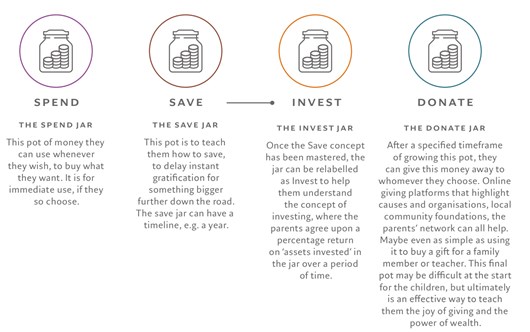
But the power of money goes beyond its ability to acquire material possessions; it enables one to help others and in so doing enjoy the rewarding feelings associated with giving. So how does one inspire children to give from an early age? One simple trick is the Spend, Save (Invest), Donate concept (see below figure). The Donate jar helps parents to instil positive values, teach empathy and engage children with philanthropy at a very early stage. The children are given the space to think about others and have a conversation about needs versus wants. They are motivated to learn about issues and discover causes that are important to them. Naturally, with the help of their parents at the beginning and then more on their own as they get older. And philanthropy is not just about money; it’s also about time. Many families volunteer together to help show their children how to help others. Young children love hands-on activities and nothing is as powerful as personal experience.
How to Engage Older Children and Young Adults
Now your children may be older but not yet played a role in your philanthropy, and you wish to change that. There is a saying that values are caught, not taught, so even if you have not yet involved them, if you as parents are generous with your time and/or capital, your children will likely have learnt to be too. But before you can expect them to join you in the family’s future or existing philanthropic endeavours, they need to feel like they have a seat at the table and understand the ‘why’. Why you are philanthropic and why you support that which you do. Bring the family together, across the generations, for a structured family meeting. Explore values: your own, those of your ancestors, or the ones who built the family wealth and those of your children. Show them the impact of your work; meet those who have benefitted from your philanthropy. In addition to helping them understand the value of giving, such experiences can be tremendous bonding exercises.
Take three jars/pots and label one Spend, another Save, (which in time will become Invest) and the last Donate. Explain to your child that with any money they get (birthdays, gifts, doing chores, allowance, etc.) they will split the money into three and deposit it equally into the containers.

And finally, listen to them. Give them scope to explore and exercise their own passions. Their interest areas often will not be the same as yours and even if they are, their approach might be different. So be open to learning from them, giving them their own allocation of the family’s philanthropic budget (see next segment) and have them report back on their work. One concept that is growing in popularity is, as a way of passing on the joys of wealth without the burdens that often accompany it, to gift ‘ownership’ of an account with an umbrella foundation (donor advised fund) to children or grandchildren. They then have total responsibility for the distribution of those funds and get to discover for themselves their own values and identity.
Employing a Tactical Allocation Strategy
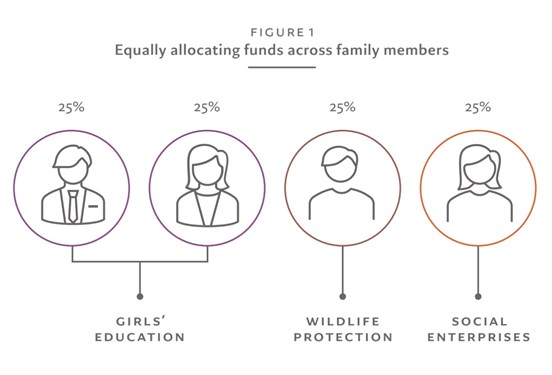
A crucial part of family philanthropy is allocating space for all members to explore and pursue their own interests. Maybe the parents are passionate about girls’ education, whereas their son is into wildlife protection and their daughter cares about supporting social enterprises.
A specific cause does not have to be that which unites the family, rather the act and the joy of being philanthropic in and of itself. One method that can help manage these often competing interests is to take an annually allocated philanthropy budget and split it tactically across the members of the family. In this example case, 25% each to allocate as they choose (see figure 1). Or perhaps there is already a family foundation in place that focuses on the parents’ passion area, e.g. girls’ education, a topic that the children are less moved by. In order to retain the mission while still providing space for the children to express themselves is to break up the budget allocation something like the below (see figure 2):
• 70% of the annual budget towards the Mission focused activities (girls’ education)
• 10% for the son to use on wildlife protection
• 10% for the daughter to use in support of social enterprises
• 8% operating expenses and
• 2% contingency funding
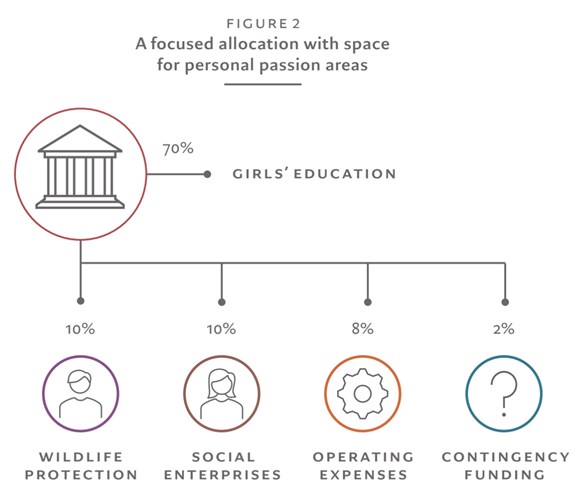
In so doing, the family foundation retains its mission, while at the same time giving the children ownership, responsibility and space to pursue their own interest areas.
Motivated by the world’s urgent needs today, The Bill & Melinda Gates Foundation plans to spend all of its assets within 50 years of the founders’ deaths, as the focus of the foundation’s trustees is on 21st-century issues. Or as one client noted ‘I don’t want my great great grandkids who won’t have known me, having to administer my philanthropy. It would be egotistical on my part and not fair on them’.
Deciding whether to Give in Life or Pertuity
A common first consideration for a family when embarking on a philanthropic journey as a unit, is whether to set something up that will perpetuate across the generations or whether to focus on what can be achieved only in this lifetime. But which is best for you, your family and the causes you care about?
Time limited / Spend down There are three predominant beliefs held among those who choose to spend down during, or shortly after, their lifetimes:
1. They are addressing causes that can be addressed and solved in the near future if sufficient resources are mobilised.
2. They wish to retain control over the spending and allocation of their own philanthropic resources rather than for someone else further down the line to potentially apply them toward causes that they would rather them not go toward.
3. They would rather not burden their children, grandchildren and beyond with the obligation to administer and manage their philanthropy.
In perpetuity On the other side, there are also three principal reasons why some families choose to set something up that will last across multiple generations:
1. They are addressing eternal causes - issues that will never be eradicated or needs that will continue. Examples include Alfred Nobel and the Nobel Prize and George Soros with his Open Society Foundation.
2. They wish to leave a legacy so that they will be remembered down the generations.
3. They wish to define and influence what it means to be part of their family and pass on the values that their family stands for.
The Sainsburys, Rockefellers, Nobels are all families whose names are with philanthropy, and who have inspired their decedents to carry forward their family’s values and impact on humanity. Or one client highlighted ‘I would like my descendants and future heirs to understand that with their inheritance comes an obligation to society and those less fortunate then they’
Ultimately, whether to be time-limited or in-perpetuity is a choice that is unique to you and your family. However, the decision is not set in stone and can be changed either within your lifetime or further down the road. But choosing one now can help to plan and build a strategy that will steer your work.
Top 5 Traits of a Successful Philanthropy Family
Family philanthropy is most successful (as measured by its positive impact both on the family and the end causes) when it is driven by a family’s values, inclusive of the interests and goals of all members of the family, voluntary and begins at an early age. In addition, there are five core commonalities across those that are most successful:
1. They have a clear vision and mission The family is aligned on what it stands for, what its end goal is and the road map to get there. Having clarity helps to provide a compass for future generations.
2. They have clear governance structures, policies and decision-making guideline Philanthropy governance is treated in the same way as the governance of a family business or investments in regard to who is involved, role allocation, staffing, decision making, leadership tenure, etc.
3. They take a long-term view A philanthropic commitment can last for generations and is a great way to pass down values. This also permits them to take a patient view of their partnerships, allowing time for relationships to form and for successes to materialise.
4. They have a strategic focus Having clarity about where they will act, what types of work, causes and organisations are supported and those that are not, provides focus and alignment among members with less room for potential conflict. However, within this, space for personal expression within the budget breakdown is allowed for.
5. They continuously review, learn and adapt Learning is an ongoing process that accompanies every philanthropic endeavour. It is core to the very fabric of one’s work and means asking smart, timely questions along the way. It involves measuring the impact on the causes supported, evaluating the systems and procedures in place and the decision making processes within the family.
Conclusion
Philanthropy is an expression of one’s deepest personal values and beliefs. Sharing and acting upon these values as a family can be a tremendously powerful experience for all family members. It can also lead to much greater longevity, reach and impact of one’s philanthropic work, as well as provide influential training grounds and learning experiences for a family’s younger members. In summary, philanthropy can be a family tradition that benefits all, if done with care, transparency and clarity.
Authors
Christoph Courth
Head of Philanthropy Services
Pictet Wealth Management
Jason Hobday
Senior Family Advisor